
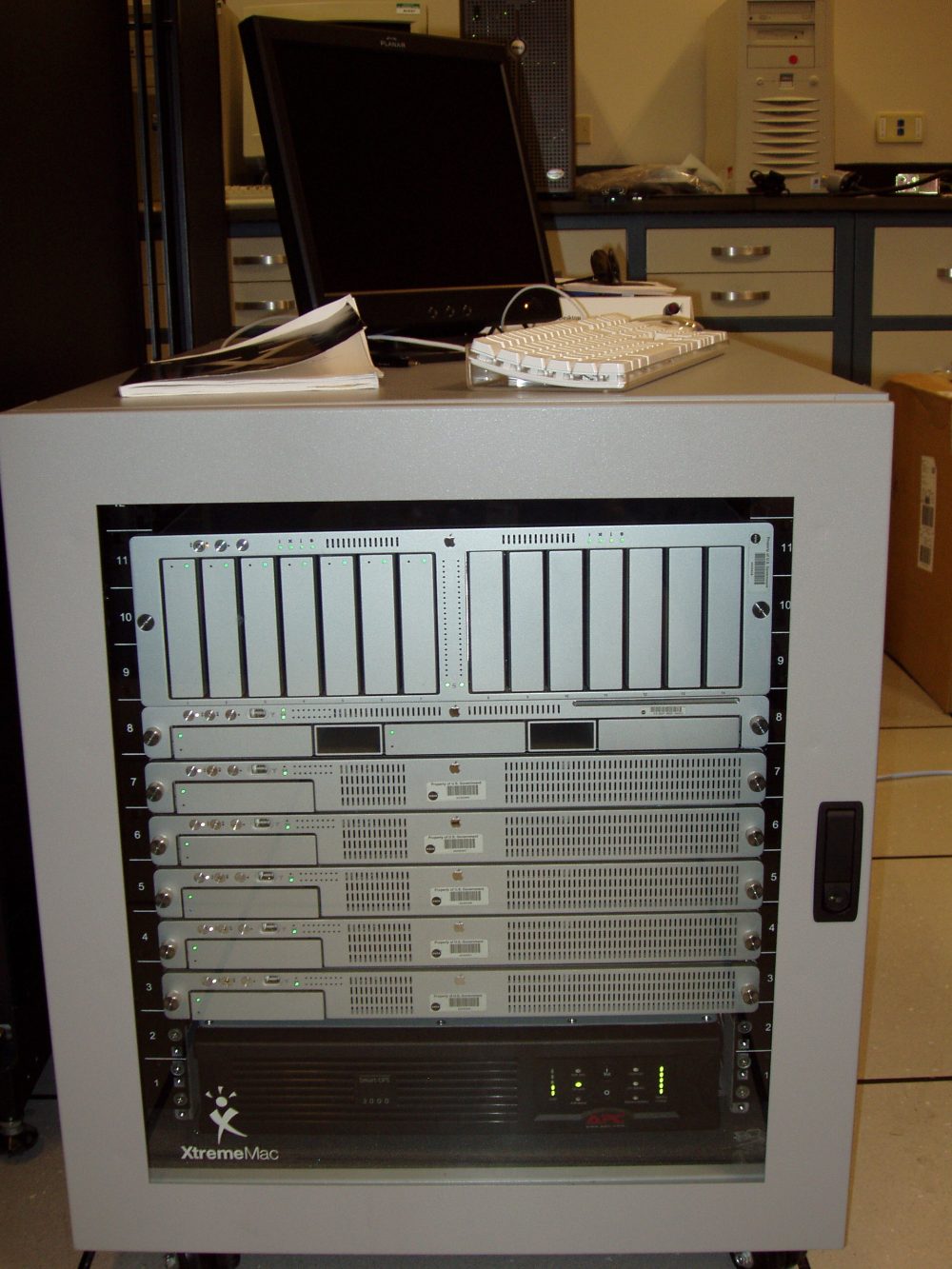
Apple could be preparing to sell servers again, potentially marking the company’s return to the commercial server market more than a decade after discontinuing the Xserve.
According to recent reporting, Apple is considering developing an AI-focused enterprise server that could be sold directly to outside companies, with a possible launch around 2029.
The project has not been officially announced by Apple, meaning its specifications, release date and even eventual commercial launch could still change.
However, if Apple moves forward, it would represent a significant expansion of the company’s Apple silicon strategy into the enterprise data-center market.
Is Apple Going to Sell Servers Again?
Potentially.
Apple is reportedly exploring an enterprise server designed primarily for artificial intelligence workloads.
Unlike the old Xserve, which was designed to handle more traditional server workloads, Apple’s potential new hardware would reportedly focus heavily on AI inference.
AI inference refers to running already-trained artificial intelligence models to generate responses, analyze information and perform other AI tasks.
That could put Apple’s server hardware in corporate data centers alongside infrastructure built around processors and accelerators from companies such as Nvidia, AMD and Intel.
When Could Apple’s New Server Be Released?
The reported target is approximately 2029.
However, Apple has not announced an official release date.
Because the project remains under development, a potential 2029 launch should be considered a reported target rather than a confirmed Apple product release.
Apple could modify the project, delay it or decide not to commercially release the server.
What Would the Apple Server Be Used For?
The reported Apple server would primarily be designed for enterprise AI workloads.
Instead of companies relying entirely on cloud providers to run AI models, businesses could potentially install Apple’s servers inside their own data centers.
This could be attractive to companies that want greater control over their AI infrastructure, data and computing resources.
The server could therefore be positioned very differently from Apple’s consumer products such as the MacBook Pro, Mac Studio and Mac mini.
It would be enterprise hardware built specifically for data-center environments.
Could Apple’s Server Use Apple Silicon?
Yes. Apple silicon would reportedly be at the center of the project.
Potential configurations have reportedly included multiple future-generation Apple Ultra chips working together inside a server system.
That would allow Apple to take the architecture it developed for Macs and scale it into much larger systems designed for AI computing.
Apple’s experience designing highly integrated hardware and software could become an important part of its server strategy.
Could Apple Work With Nvidia on the Server?
One particularly interesting possibility is that Apple’s server could incorporate technology from Nvidia.
Apple is reportedly considering using Nvidia’s NVLink Fusion technology, which is designed to help connect processors and accelerators inside advanced AI infrastructure.
Such an arrangement would not necessarily mean Apple would abandon its own chips.
Instead, Apple silicon could potentially remain the main computing architecture while Nvidia technology helps connect components together in larger AI systems.
The final architecture has not been announced.
Does Apple Already Make Servers?
Yes, but there is an important distinction.
Apple already develops specialized server infrastructure for its own services.
One of the most important examples is Private Cloud Compute, which Apple developed to support more computationally intensive Apple Intelligence requests while maintaining its privacy and security approach.
Private Cloud Compute uses Apple silicon-based server hardware.
The major difference is that Apple currently builds this infrastructure primarily for its own cloud operations rather than selling those servers as commercial products that businesses can purchase.
The reported server project could change that.
What Is Apple Private Cloud Compute?
Private Cloud Compute is Apple’s cloud infrastructure designed to process certain Apple Intelligence requests that require more computational power than can be provided directly by an iPhone, iPad or Mac.
Instead of relying exclusively on conventional cloud-server architectures, Apple designed specialized systems using Apple silicon.
That means Apple has already gained experience operating Apple silicon at the server level.
Commercializing similar expertise for enterprise customers would be a significant next step.
Is Apple Bringing Back Xserve?
Not exactly.
Apple’s reported server project should not necessarily be considered an Xserve revival.
Xserve was Apple’s rack-mounted server platform introduced in 2002.
Businesses, universities and other organizations could purchase Xserve systems for traditional server applications.
Apple eventually discontinued Xserve in 2011, effectively ending its dedicated commercial server hardware business.
A future Apple AI server would enter a dramatically different market.
Rather than simply bringing Xserve back, Apple could build an entirely new server platform around Apple silicon and artificial intelligence.
What Was Apple Xserve?
Xserve was Apple’s rack-mounted enterprise server.
Introduced in 2002, Xserve was designed for organizations that wanted server hardware running Apple’s software ecosystem.
Over its lifetime, Xserve went through multiple generations and eventually transitioned to Intel processors following Apple’s broader move from PowerPC to Intel.
Apple discontinued Xserve in 2011.
The company subsequently concentrated much more heavily on consumer hardware and increasingly relied on products such as the Mac mini and Mac Pro for customers needing Mac-based server solutions.
A new AI server would therefore mark Apple’s first major return to selling dedicated server hardware in many years.
Why Would Apple Return to the Server Market?
Artificial intelligence has dramatically increased demand for data-center computing power.
Companies building and operating AI applications need enormous amounts of computing infrastructure to train and run AI models.
Apple also now controls its own processor architecture through Apple silicon.
The company has demonstrated that its chips can scale from devices such as the iPhone to powerful desktop systems and specialized cloud infrastructure.
Selling enterprise AI servers could give Apple another way to capitalize on that technology.
It could also expand Apple beyond personal computing devices and services into the rapidly growing AI infrastructure market.
Would Apple’s Server Run macOS?
That remains unclear.
Apple has not announced the server, its operating system or its software environment.
A dedicated AI server would not necessarily need to operate like a conventional Mac running standard macOS.
Apple could instead develop specialized server software optimized for AI inference, enterprise management, virtualization, security and data-center deployment.
More details would likely emerge if Apple eventually turns the reported project into a commercial product.
Is Apple Officially Returning to the Server Business?
Not yet.
As of September 16, 2026, Apple has not officially announced a new commercial server.
The company is reportedly considering an AI-focused enterprise server with a possible launch around 2029.
Therefore, it would be premature to say that Apple has officially revived its server business.
The more accurate description is that Apple is reportedly exploring a return to selling dedicated enterprise server hardware.
If the project reaches the market, it could become one of Apple’s most significant expansions into enterprise computing since the Xserve era—and potentially establish Apple silicon as a serious competitor in the rapidly expanding AI data-center market.