
Sleep tracking has evolved far beyond smartwatches and fitness bands. For people who don’t want to wear a device to bed every night, under-mattress sleep tracker mats have become an attractive alternative. These ultra-thin sensors slide beneath your mattress and automatically monitor your sleep without requiring charging or nightly setup.
While the category isn’t as crowded as wearable sleep trackers, there are still several excellent options available depending on your budget and needs.
Why Choose an Under-Mattress Sleep Tracker?
Unlike smartwatches or smart rings, sleep tracking mats work passively. Simply place the sensor under your mattress once, connect it to Wi-Fi or Bluetooth, and it automatically begins recording your sleep every night.
Most sleep tracker mats can monitor:
- Sleep duration
- Sleep stages (Light, Deep, REM)
- Heart rate
- Respiratory rate
- Body movement
- Snoring
- Sleep interruptions
- Sleep quality score
Because there is nothing attached to your body, many users find them far more comfortable for long-term sleep tracking.
1. Withings Sleep
Withings Sleep Tracker Mat
$199.99
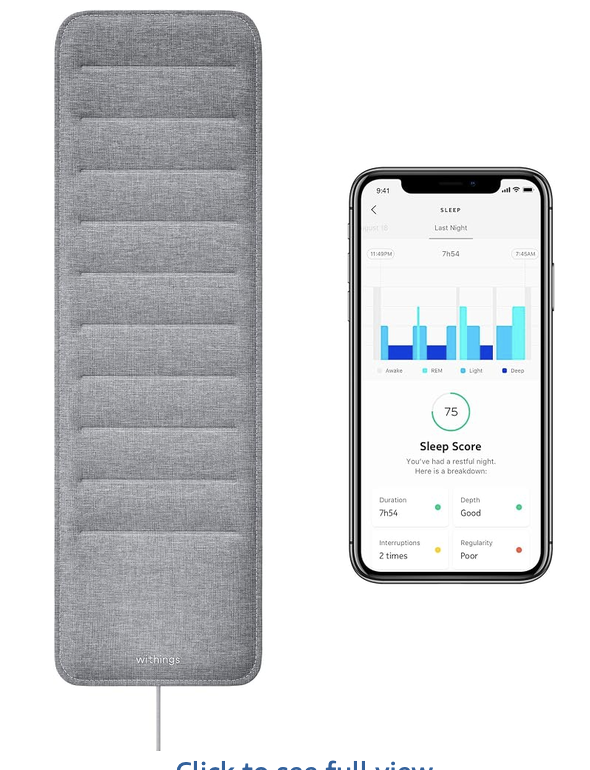
The Withings Sleep remains the best-known consumer sleep tracking mat on the market.
Placed underneath the mattress, it uses pneumatic sensors and ballistocardiography technology to detect tiny body movements associated with heartbeat and breathing. It tracks:
- Sleep cycles
- Heart rate
- Heart rate variability
- Respiratory rate
- Snoring
- Sleep Score
- Breathing quality
The device requires no charging and automatically syncs data to the Withings app each morning. It also integrates with Apple Health and Google Health Connect. Withings says the device was developed alongside sleep physicians and validated against polysomnography (PSG), the gold standard for sleep studies. (Withings)
2. Eight Sleep Pod
Eight Sleep takes a different approach by combining an under-mattress sensing system with an active temperature-regulating mattress cover.
Instead of only monitoring sleep, the system can:
- Automatically cool or warm each side of the bed
- Track sleep stages
- Monitor heart rate
- Measure respiratory rate
- Track HRV
- Generate daily recovery scores
It’s considered one of the most advanced smart sleep systems available, although it is significantly more expensive than standalone sleep mats.
3. Emfit QS
Originally designed for athletes and researchers, the Emfit QS is another under-mattress sensor that emphasizes recovery tracking.
Its primary metrics include:
- Resting heart rate
- Heart rate variability
- Respiratory rate
- Sleep duration
- Recovery readiness
Many endurance athletes use the Emfit QS because HRV trends can help monitor training load and recovery.
4. Beautyrest Sleeptracker
Beautyrest offers sleep tracking technology built directly into compatible mattresses and adjustable bases.
Rather than purchasing a separate mat, the sensors are integrated into the bed itself.
Features include:
- Sleep stages
- Heart rate
- Breathing rate
- Snore detection
- Sleep coaching
This option is best suited for shoppers already purchasing a new Beautyrest mattress or adjustable base.
5. Apple Beddit 3 (Discontinued)
Apple Beddit 3 Sleep Monitor
$157.99
Apple acquired Beddit in 2017, and the Beddit 3 became one of the earliest consumer sleep sensor strips.
The device measured:
- Sleep duration
- Heart rate
- Respiration
- Snoring
- Bedroom temperature
- Humidity
However, Apple discontinued Beddit several years ago, and it is no longer actively developed. While remaining inventory and used units can still be found, buyers should know the platform is no longer receiving meaningful updates.
Why Aren’t There More Sleep Tracker Mats?
Despite their convenience, under-mattress sensors present several engineering challenges.
Manufacturers must accurately detect tiny heart vibrations through multiple inches of foam while filtering out movement from partners, pets, and different mattress materials. Memory foam, hybrid, latex, and pillow-top mattresses can all affect sensor performance.
Additionally, validating features such as sleep apnea detection requires extensive clinical testing and regulatory approval, making development expensive. These challenges have pushed many companies toward wearable devices or radar-based sensors instead.
Sleep Mats vs. Wearables
Both approaches offer advantages.
Sleep Tracker Mats
Pros
- Nothing to wear
- No charging
- Automatic nightly tracking
- Comfortable for long-term use
- Excellent for people who dislike watches or rings
Cons
- Limited portability
- Usually monitors one sleeper
- Accuracy depends on mattress type
Wearables
Pros
- Track sleep anywhere
- Measure daytime activity
- Often include blood oxygen and skin temperature
- Better ecosystem integration
Cons
- Must be worn overnight
- Require charging
- Some users find them uncomfortable while sleeping
Which Sleep Tracker Mat Is Best?
For most consumers, the Withings Sleep continues to be the best dedicated under-mattress sleep tracker thanks to its comprehensive health metrics, automatic operation, and mature software ecosystem. (Withings)
Those looking for premium sleep optimization may prefer the Eight Sleep Pod because of its automatic climate control and recovery analytics, while athletes often gravitate toward the Emfit QS for heart rate variability monitoring.
Although the market for under-mattress sleep tracking systems remains relatively small, these devices continue to offer one of the easiest and most comfortable ways to monitor sleep without wearing a smartwatch or smart ring every night.